
PhD student, Michael Lewis, presents Synthesis and Growth of Bulk Cs2TeX6 (X = Cl, Br) Crystals for Various Scintillation Applications
Date
Friday November 27, 202611:30 am - 12:30 pm
Location
Chernoff Hall, Room 117Synthesis and Growth of Bulk Cs2TeX6 (X = Cl, Br) Crystals for Various Scintillation Applications
Michael P. Lewis
Wang Group/Lee Group
Emerging scintillator materials, like the anti-fluorite-type A2BX6 compounds (A = monovalent cation, B = tetravalent cation, and X = halide), have gained rapid interest in optoelectronic and scintillation applications. The materials' compositionally versatile [BX6]2- octahedra allow for tunable optoelectronic properties by altering the metal-halide bonding. Furthermore, the ability to incorporate tellurium, including the neutrinoless double beta decay (0νββ) candidate isotope 130Te, motivates the development of bulk Cs2TeX6 (X = Cl, Br) single crystals as potential scintillating bolometers, which can simultaneously detect heat and light to improve background rejection, resulting in enhanced experimental sensitivity.
This seminar will present the development of a highly reproducible, high-yielding solution synthesis method for synthesizing Cs2TeX6 (X = Cl, Br) powder using inexpensive, low-purity TeO2 and Cs2CO3, followed by the first reported bulk single-crystal growth using the Bridgman-Stockbarger method. Cs2TeBr6 crystals were grown up to Æ8 ´ 45 mm, and Cs2TeCl6 crystals were grown up to Æ21 × 70 mm with excellent phase purity. Elemental impurities were tracked throughout the production process by inductively coupled plasma mass spectrometry. Single-crystal X-ray diffraction, photoluminescence (PL), and Raman spectroscopy provided insights into the lattice dynamics and luminescence properties. Furthermore, Cs2TeCl6 scintillation measurements with a silicon photomultiplier show an improved full-width at half-maximum energy resolution from 38% at room temperature to 18% at 91 K for the 137Cs 662 keV photopeak. Moreover, future cryogenic bolometer measurements of Cs2TeCl6 crystals will evaluate these materials’ potential as scintillating bolometers at ~10 mK.
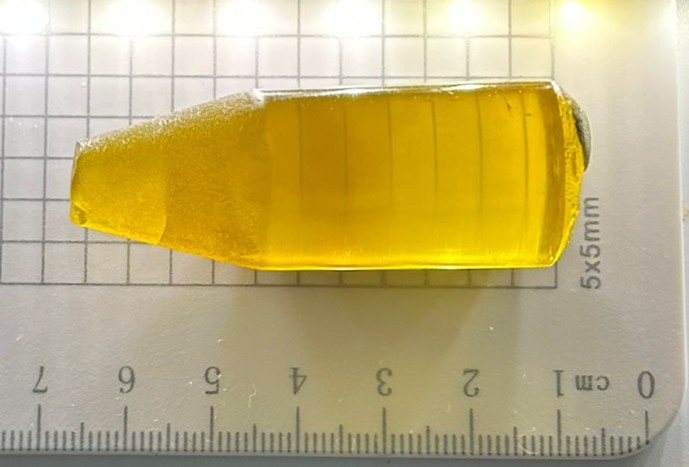
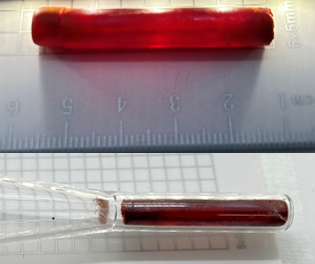
Figure 1. Grown single crystals of Cs2TeCl6 (left) and Cs2TeBr6 (right).