
PhD student, Mark Aloisio, presents Design and Application of N-Heterocyclic Carbenes as Area Selective Atomic Layer Deposition Precursors.
Date
Friday July 24, 202611:30 am - 12:00 pm
Location
Chernoff Hall, Room 117Design and Application of N-Heterocyclic Carbenes as Area Selective Atomic Layer Deposition Precursors.
As microelectronics are ever-increasingly present in everyday applications, efficient preparation and protection of these small circuits has become critical. With the global demand for smaller and more powerful components grows, the need for precision manufacturing increases as well. Top-down manufacturing through photolithography can lead to edge placement errors resulting in short-circuits or misaligned networks.1 However, bottom-up processes, such as Atomic Layer Deposition (ALD), utilize molecular interactions over physical barriers to improve precision manufacturing through area selective (AS) deposition.2 One example of these molecular interactions is that of N-heterocyclic carbenes (NHC) to metal surfaces. These modular organometallic ligands, classically used in homogeneous catalysis, have recently been applied to material interfaces. Their self-assembly on metals afford a uniform and cohesive monolayer that can be utilized to protect the underlying metal from degradation or harsh chemical environments.3 In this seminar, the design of these NHC ligands as ALD precursors will be discussed with desired characteristics for these applications.4 Further, the use of these precursors will be showcased to exemplify the area selectivity of the carbene deposition to metal over dielectric surfaces.5
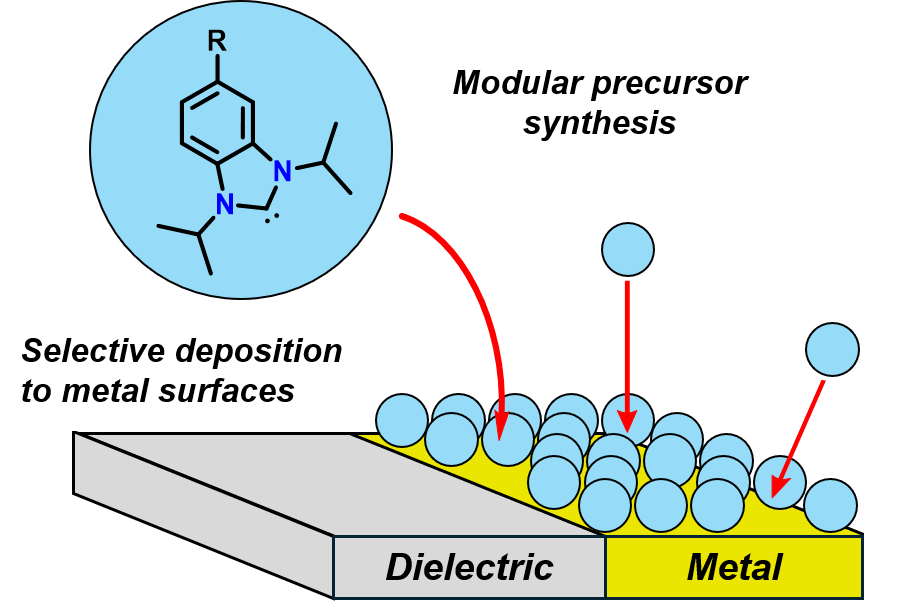
Fig 1: Representative figure of NHC ligands applied in Area Selective Atomic Layer Deposition
(1) Gabor; et al. Journal of Micro/Nanolithography, MEMS, and MOEMS 2018, 17 (4), 041008
(2) Johnson; et al. Materials Today 2014, 17 (5), 236-246
(3) Crudden; et al. Nature Chemistry 2014, 6 (5), 409-414
(4) Goodwin; et al. Journal of Vacuum Science & Technology A 2025, 43 (6),
(5) Lomax; et al. Chemistry of Materials 2024, 36 (11), 5500-5507