
PhD student, Alex MacDonald, presents A CO2-switchable electrolyte solution as a recyclable medium for organic electrochemical reductions
Date
Friday August 28, 202611:30 am - 12:00 pm
Location
Chernoff Hall, Room 117A CO2-switchable electrolyte solution as a recyclable medium for organic electrochemical reductions
Organic electrochemistry has been long promised as a greener synthetic tool than using traditional chemical oxidants and reductants. Despite much progress in the field, the environmental harm and cost of the required solvent and electrolyte salt, as well as the challenge of separating products from these auxiliaries, remain issues for both research and industrial adoption. We propose a new solvent system which serves as medium, electrolyte, and separation aid. A CO2-switchable amine dissolved in water may be partially protonated by addition of a small amount of CO2, allowing the amine to act as an electrolyte during an electrochemical reaction, and then nearly fully protonated upon post-reaction CO2 addition, salting out the product from the aqueous phase. After removal of the product by decantation or filtration, CO2 may then be removed from the solution, allowing the aqueous amine to be reused in subsequent reactions. Reductions of benzophenone and acetophenone were performed using this method. The water/amine solution was used for multiple cycles with minimal loss in yield and Faradaic efficiency (FE) of the reduction product, and no loss in efficacy of the amine. Expanding the types of solvents compatible with electrolysis and facilitating the separation of product from auxiliaries are important steps in reducing the environmental harm of organic electrochemistry and improving the industrial viability of the technology.
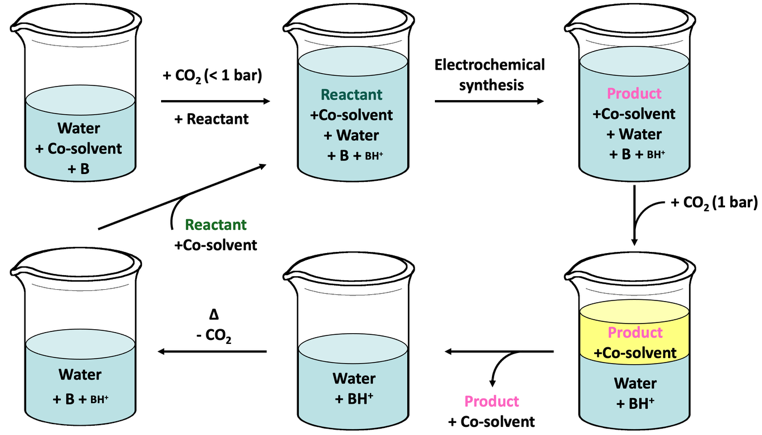
Figure 1: Process diagram of the CO2-switchable electrolyte. The amine (B) may be reversibly protonated by CO2 addition to produce ammonium bicarbonate ions (BH+) both to lower the electrical resistance of the solution, and to facilitate product separation.