
Dr. Marco Taucer presents Inverted-Mode STM: A New Approach for Atom-by-Atom Fabrication
Date
Friday May 15, 202611:30 am - 12:30 pm
Location
Chernoff Hall, Room 117
Inverted-Mode STM: A New Approach for Atom-by-Atom Fabrication
Abstract:
Building with atomic precision, atom by atom, represents an ultimate frontier in our ability to shape the world and serves as the basis for an emerging set of quantum technologies based on atomic-scale features. The Scanning Tunneling Microscope (STM) is the most powerful tool we have for manipulating atoms. Usually, it works by using a sharp metal tip to move atoms on a sample surface. This works well in many cases, particularly when the surface atoms are weakly bound, or physisorbed, but becomes more difficult for stronger covalent bonds. It contends with another longstanding challenge in STM: the configuration of atoms on the tip is generally hard to ascertain and hard to control, making reproducibility an issue. In this talk, I will present a new approach to STM that we call “Inverted-Mode” STM. It uses an engineered tip with a clean and flat atomic terrace at its apex, which serves as a build-site. This “apex terrace” can then be imaged by tailor-made tall, sharp molecules on the sample, inverting the usual paradigm of STM. The first advantage of this setup is that it allows unprecedented control of both sides of the tunnel junction. More importantly, it is a platform for controlled chemical reactions. The apex terrace and the protruding molecule can be thought of as reagents whose relative positions can be controlled with sub-angstrom precision to effect individual chemical reactions. I will show that these reactions give reproducible outcomes, can be applied sequentially to the same build site, and can be used to either add or remove atoms. In short, I will explain how this is the basis for a broad capability for atomically precise fabrication.
Bio:
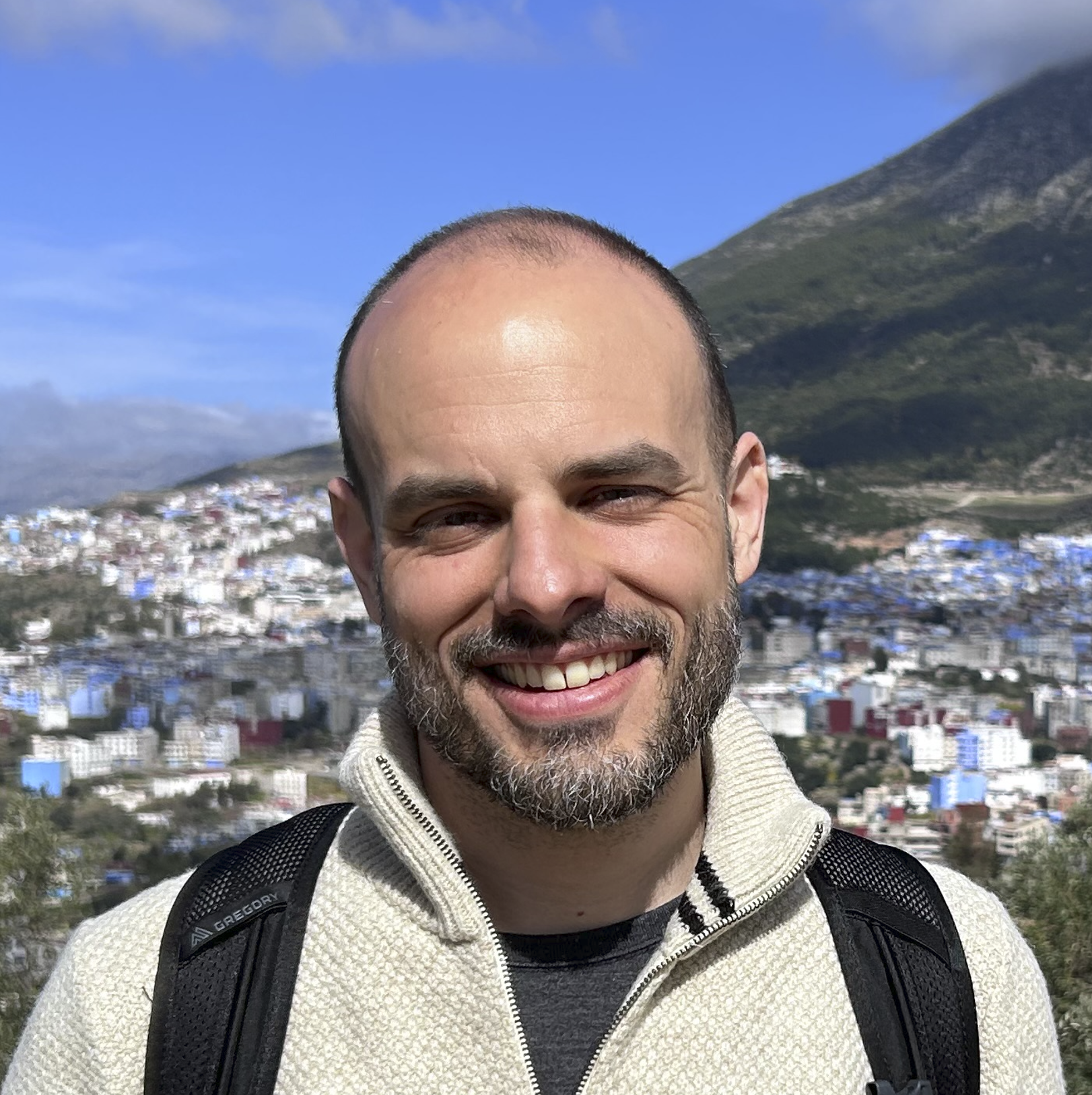 Marco Taucer is a Principal Scientist at CBN Nanotechnologies in Ottawa, Canada. He is Deputy Director of the Experimental Department and head of its current research program. His research focuses on developing new tools for atomically precise fabrication based on silicon surface science and scanning probe microscopy. He received a B.Sc. in Physics from McGill University and a PhD from the University of Alberta, where his research was focused on non-equilibrium charge dynamics of silicon dangling bonds. He did a postdoc at the University of Ottawa, and later at the National Research Council, in solid-state attosecond science. He has been involved in commercialization of atomic-scale technologies since 2013 when he joined Quantum Silicon, an Edmonton-based startup. He joined CBN Nanotechnologies in 2020.
Photo: