
Dr. Keith G. Andrews presents Robust Organic Cages as Enzyme Mimics: Symmetry-Reduction, Cavity-Tuning and Catalysis
Date
Tuesday July 21, 20269:30 am - 10:30 am
Location
Chernoff Hall, Room 117Robust Organic Cages as Enzyme Mimics: Symmetry-Reduction, Cavity-Tuning and Catalysis
Keith G. Andrews – Durham University, UK
Enzymes achieve catalytic rate enhancements as high as 1019 over background, and macromolecular chemists have long sought to use artificial cavities to study and mimic enzyme proficiencies. The Andrews Group has developed robust polyamide cages featuring an active site similar to glycoside hydrolases and aspartyl proteases. Our organic cages are self-assembled, locked to prevent disassembly, and then investigated as organocatalysts and hosts (sensors). In this talk, I will introduce supramolecular catalysis, and present our recent report of the first organic cage enzyme mimic performing structurally-promoted organocatalysis,1 including kinetics, mechanism, crystallography, and computational studies. I will also explain how we can tune the cage cavity by harnessing emergent geometric rules to break symmetry in symmetric topologies,2-4 towards the sustainable synthesis of functionalised biomolecules. Finally, we ask what these mimics can reveal about enzyme catalysis, including how electric fields can be used to augment catalysis independent of traditional through-bond activation modes,5 and the role of flexibility in catalysis.
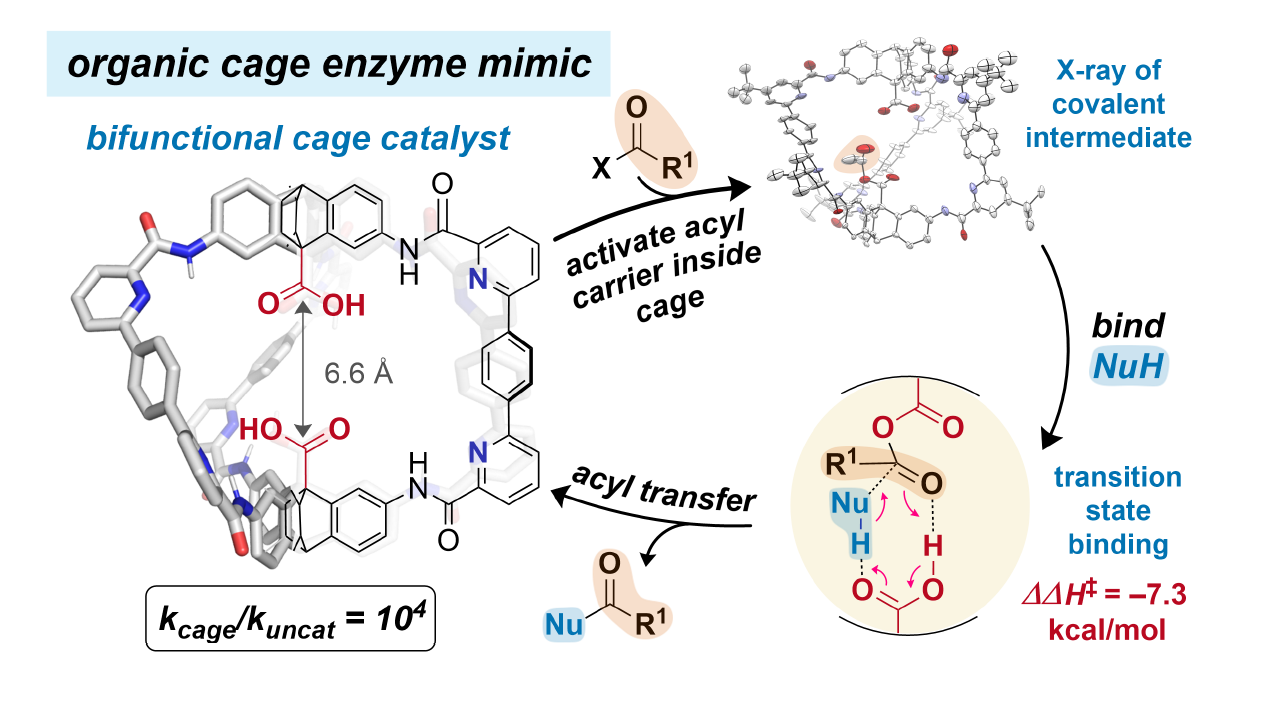
1. J. Am. Chem. Soc. 2024, 146, 26, 17887–17897
2. Chem. Sci. 2024, 15, 6536-6543
3. Chem. Commun. 2024, 60, 6023-6026
4. Chem. Eur. J. 2023, 29, e202300063
Biography
https://www.durham.ac.uk/staP/keith-g-andrews/ https://www.kga-lab.co.uk/
Dr. Keith G. Andrews received his MChem from Imperial College London, where he worked with Prof. Alan Spivey to develop a computational approach to remove systematic error in Density Functional Theory (DFT) NMR shift predictions, and on the first industrial validation of PROTACs at GSK. He moved to start his PhD with Prof. Ross Denton at the University of Nottingham in 2013, where he developed an organocatalytic Mitsunobu reaction for the inversion of secondary alcohols, and new reductive amination methodologies using hydridosilanes. Following a short PDRA position with Ross, in 2018, Keith moved to the University of Oxford for post-doctoral research with Prof. Harry Anderson to work on supramolecular porphyrin arrays. In 2019, he was awarded a Royal Commission 1851 Research Fellowship to begin independent work on low molecular weight enzyme mimics for catalysis and molecular recognition, hosted in the lab of Harry Anderson, and joined Linacre College as an EPA Research Fellow. In 2023 he moved to Durham University, UK, to start his research group, where he continues to research organic cages as catalysts and enzyme mimics.