
Dr. Dongling Ma presents the Jones Lecture
Date
Friday March 6, 202611:30 am - 12:30 pm
Location
Chernoff Hall, Room 117Towards Broadband Photocatalysis
Forming nanomaterials junctions and using plasmons represent two important, promising strategies for realizing broadband photocatalysis in strategically important applications such as solar fuels and photocatalytic degradation of pollutants in our environments. In this talk, I will present some of our recent work on the rational design and realization of nanohybrid materials as well as their applications in solar fuel and photocatalysis. For instance, the construction of homojunctions of nanoplates made of metal–organic frameworks (MOF) led to broadened light absorption and increased photoactivity. The well-defined MOF homojunction was prepared by a facile one-pot synthesis route directed by hollow transition metal nanoparticles. The homojunction is enabled by two concentric stacked nanoplates with slightly different crystal phases. The enhanced charge separation in the homojunction was visualized by in-situ surface photovoltage microscopy. The as-prepared nanostacks displayed a visible-light-driven carbon dioxide reduction with very high CO selectivity, and excellent stability. Another example is about the in situ synthesis of plasmonic Ag nanoparticles (AgNPs) and Ag-MOM (metal organic matrix) using one-step facile approach. The intimate and stable interface between the AgNPs and Ag-MOM and hot electron transfer from the plasmonic AgNPs to MOM led to highly efficient visible-light photocatalytic H2 generation in aqueous solution, which surpasses most of reported MOF-based photocatalytic systems. This work sheds light on effective electronic and energy bridging between plasmonic NPs and metal organic matrix.
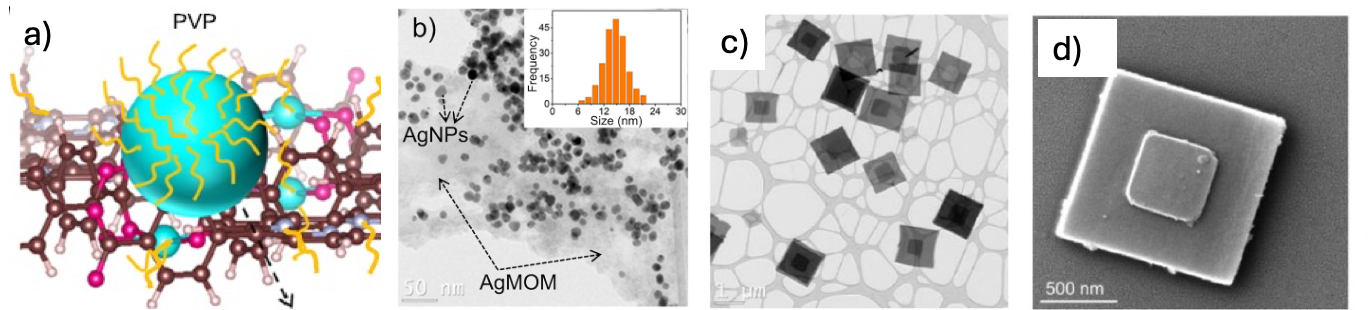
Figure 1. a) Schematic illustration of the model of a AgNP chemically linked with MOM [1]; b) typical TEM image of Ag–AgMOM. Inset is the statistical size distribution of AgNPs [1]; c) typical TEM image of Co-MOF nanostacks [2]; and d) SEM image of a nanostack [2].
Related References: [1] Nat. Commun., 2021, 12, 1231; [2] Nat. Commun., 2023, 14, 541; [3] Chem. Mater., 2021, 33, 695; [4] Adv. Funct. Mater. 2023, 2212301; [5] Nat. Water, 2026, accepted; [6] Nano Lett., 2024, 24,10987; [7] Nano Lett., 2023, 23, 12, 5842.
|
|
Biography:

Prof. Dongling Ma (FCIC, FRSC, FIAAM), holder of the Canada Research Chair (Tier 1) in Advanced Functional Nanocomposites, has been a professor at Institut national de la recherche scientifique (INRS) since 2006. Her main research interest consists in the development of various nanomaterials (e.g., semiconductor quantum dots, transition metal catalytic nanoparticles, plasmonic nanostructures) for applications in energy, environment, catalysis and biomedical sectors. She has co-authored >200 articles in a broad range of areas, centered on materials science, in selective, high-impact journals such as J. Am. Chem. Soc, Nat. Commun., Nat. Water, Adv. Mater., Adv. Energy Mater., ACS Nano, Adv. Funct. Mater., Energy Environ. Sci., Chem. Mater. and Chem. Soc. Rev. with a H-index of 76 (Google Scholar). She has co-authored 7 granted patents and 4 book chapters. She has delivered >170 invited speeches at international conferences and prestigious universities/government laboratories. She is an associate editor of ACS Applied Nano Materials and also serves/served on multiple journal editorial advisory boards, including the prestigious ACS Energy Lett., ACS Mater. Lett., Sci. Rep., etc. She also acted as the section Editor-in-Chief for the section “Solar Energy and Solar Cells” of Nanomater., and the Section Editor of National Science Review. Her recent awards include election as a Fellow of the Chemical Institute of Canada (2026) and Fellow of the Royal Society of Chemistry (UK, 2023), and 2022 Clara Benson Award from the Chemical Institute of Canada.